Cart abandonment sits at roughly 70% across e-commerce, which sounds alarming until you realize it is close to universal. The real gap between stores that recover meaningful revenue from it and stores that do not is not whether they have an abandoned cart email at all — most platforms send a basic one by default. The gap is in the sequence, the timing, and what each email actually says.
Why a Single Reminder Email Is Not Enough
The default abandoned cart email most Shopify and WooCommerce stores rely on is a single message sent about 24 hours after someone leaves without buying. It works, but only a little. A shopper who abandons a cart is doing so for a mix of reasons — distraction, price hesitation, comparison shopping, a slow checkout — and a single generic reminder cannot address all of them. A proper sequence gives three separate chances to catch a different objection.
The Timing That Actually Works
Across current benchmarks, the pattern that performs best is a three-email sequence spaced roughly like this:
- Email 1, sent 30 to 60 minutes after abandonment — while intent is still warm and before the browser tab even closes.
- Email 2, sent 18 to 24 hours later — once the initial distraction has passed, aimed at addressing a specific objection.
- Email 3, sent 48 to 72 hours later — a final nudge, often the only one that includes a real incentive.
New visitors tend to respond better to the slower end of that range, while returning customers who already trust the store can be reminded sooner. If a store also sends SMS or push notifications around cart abandonment, timing needs to be coordinated across channels rather than planned for email alone — two reminders arriving five minutes apart on different channels reads as spam, not helpfulness.
What Each Email Should Actually Say
Email 1 should stay simple and low-pressure: a clear image of the item left behind, a one-click button back to the cart, and nothing pushier than that. No discount here yet — most people who click through this fast just needed a reminder, and offering a discount immediately trains shoppers to always wait for one.
Email 2 is where objections get addressed directly. This is the email for reviews, star ratings, shipping details, return policy, and any trust signals the store has — security badges, guarantees, real customer photos. If price was the objection, this is also a reasonable place to mention free shipping thresholds or payment plan options if the store has them.
Email 3 is the closing nudge, and the one email in the sequence where a modest incentive earns its place — a small discount, free shipping, or a mention that stock on a specific item is limited. Saving the incentive for last matters: leading with a discount in email 1 trains repeat shoppers to abandon on purpose and wait for the coupon.
Subject Lines Worth Testing
A few patterns consistently outperform a generic reminder subject line:
- Direct and plain: “You left something behind”
- Curiosity-led: “Did you see something you liked?”
- Urgency, used sparingly and only when true: “Still available, but not for long”
- Incentive-forward, reserved for email 3 only: “Here is 10% off to finish your order”
Avoid putting a discount in the subject line of email 1 or 2 — it undercuts the point of holding the incentive back for the final message.
The Content Details That Move the Numbers
A few smaller details consistently separate high-performing sequences from average ones. Personalization matters more than most stores assume — using the customer name and showing the actual product image and price, rather than a generic cart icon, measurably increases click-through. Cost objections are worth addressing head-on: a large share of shoppers abandon specifically because of unexpected costs like shipping or taxes revealed at checkout, so being upfront about total cost earlier in the funnel, not just in the recovery email, reduces how often this sequence is even needed. And because most of this traffic opens on a phone, single-column layouts with a large, tappable button back to checkout are not optional.
Setting This Up Without Living Inside a Flow Builder
Building a three-email sequence like this manually in most email platforms means clicking through a visual flow builder, setting delay conditions, and testing each branch. It is not difficult, but it is time most store owners do not have spare, and it is exactly the kind of task that AI-assisted email tools have started to take over. With Omnisend’s pre-built automation templates and AI-assisted tools, a sequence like this can be set up in minutes rather than built manually node by node, which matters most for stores running lean without a dedicated marketing hire.
If email marketing more broadly is something your Shopify store has not gotten fully set up yet, an abandoned cart sequence is usually the single highest-leverage place to start, simply because the traffic is already there — it just has not converted yet.
A Realistic Sequence, Written Out
To make this concrete, here is roughly how a three-email sequence reads in practice for a mid-size online store:
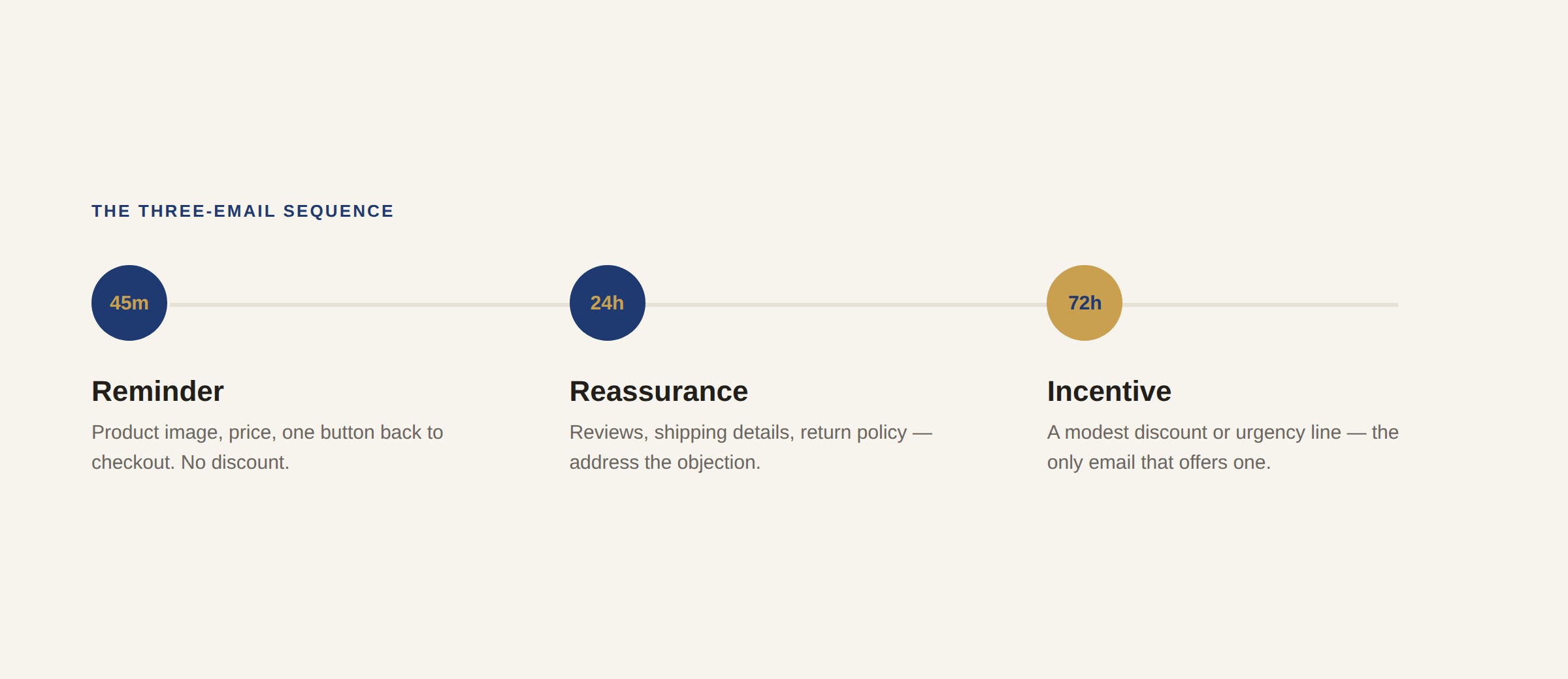
Email 1 (sent 45 minutes later). Subject: “You left this in your cart.” Body: a photo of the exact item, its price, and a single button labeled “Finish checkout.” Two sentences of copy at most, no discount mentioned anywhere.
Email 2 (sent the next morning). Subject: “Still thinking it over?” Body: the same product, plus three or four short trust signals — a star rating with review count, free returns within 30 days, and estimated delivery time. This is also where a founder note or a short customer quote tends to help, since it addresses hesitation rather than repeating the same reminder.
Email 3 (sent two to three days later). Subject: “Here is 10% off to complete your order.” Body: the product again, the discount code, and a light urgency line if genuinely true, such as low stock on that specific item or a code expiring in 24 hours.
Three emails, three distinct jobs: reminder, reassurance, incentive. Sending all three with the same message defeats the purpose of spacing them out in the first place.
How to Know If It Is Working
The metric that matters is recovered revenue, not open rate. A useful way to check: compare total abandoned cart value against actual revenue recovered through the sequence over a 30-day window. Average click rates on abandoned cart emails sit around 6% overall, but stores in the top tier of senders see closer to 11%, largely due to better timing and more relevant content rather than any single trick. If a store is currently relying on a single default email, moving to a proper three-email sequence is usually the fastest way to close that gap.
The Bottom Line
A three-email sequence, spaced at roughly 45 minutes, 24 hours, and 72 hours, with the incentive held back for the final message, consistently outperforms the single generic reminder that most stores ship with by default. None of the individual pieces here are complicated. The stores that recover meaningful revenue from abandoned carts are simply the ones that actually built the full sequence instead of stopping at the default.